Arthur McInnis Platform · Hub 1
Victoria needs housing policy that shows its math, protects existing affordability, and distributes growth fairly across neighbourhoods.
- The Housing Math
- Why “Just Build More” Won’t Solve Victoria’s Housing Crisis
- The Higher the Floor, the Higher the Price
- The Missing Middle Report Card
- Who Pays
- Who Should Bear Victoria’s Housing Burden?
- What Renters in Victoria Need to Know Before the Next Election
- Tenant Protections, Election Timing, and the Politics of "Looking Into It"
- The Political Record
- The Voting Record Behind the Rhetoric and How a Deliberate Council Bloc Dismantled Victoria’s Affordability Baselines
- NDP Provincial Government Clear Cuts Old Growth While Victoria NDP Municipal Government Clear Cuts Old Neighbourhoods
These pieces establish the central test: if City Hall says more supply will restore affordability, it should show who benefits, at what price point, and on what timeline.
Hub 1 · Housing · The Housing Math
Why “Just Build More” Won’t Solve Victoria’s Housing Crisis
“Build more housing.” It is the dominant prescription in Victoria’s housing debate, invoked by Councillors, developers, housing advocates, and provincial ministers. Build more, the argument goes, and supply will respond to demand, prices will fall, and the affordability problem will eventually resolve itself.
It is a plausible theory. It is not, however, a plan. And in Victoria’s specific market conditions, the evidence that it will work at the speed, scale, and price point required to meaningfully help the people most affected by the housing crisis is considerably weaker than its advocates acknowledge.
They should show the math.
What the Supply Theory Actually Claims
The supply argument rests on a straightforward economic logic: housing prices are high because demand exceeds supply. Increase supply and prices will moderate. In a free market with elastic supply and no structural barriers, this is broadly correct over time.
The problem is not the theory. The problem is its application in a market with Victoria’s specific characteristics, on a timeline relevant to the people currently priced out. Victoria is a constrained island geography with a fixed land base, strong amenity demand from across Canada, a significant investor and short-term rental presence, a construction sector operating at or near capacity, and a household income distribution that makes most new construction economically inaccessible to the people most affected by the crisis. None of these factors makes supply irrelevant. All of them mean that supply alone will not solve the problem without a set of accompanying policies that Victoria’s current council has shown no appetite to adopt.
The Vacancy Rate Problem
Victoria’s purpose-built rental vacancy rate has hovered between 1.0 and 2.0 percent for most of the past decade, well below the 3 percent conventionally treated as a balanced rental market. A vacancy rate this low indicates a market under persistent excess demand. Building more supply will help at the margin. But closing a structural deficit at the 1 to 2 percent level barring some other external factor requires sustained volume at a rate Victoria has never historically achieved, and the construction sector does not have the capacity to deliver it at the speed required.
CMHC’s own research estimated that Canada would need to build approximately 3.5 million additional units above current projections by 2030 to restore affordability to 2004 levels. Victoria’s proportionate share of that national deficit runs to thousands of units above current construction rates. No realistic projection of current housing starts closes that gap in under a decade. The people priced out now are not being told to wait until 2035.
Who Is the New Supply Actually For?
The supply argument assumes that new housing supply, at whatever price point it is built, eventually filters down to lower price points over time. This is the “filtering” model: today’s luxury condo becomes tomorrow’s affordable unit as it ages and its relative quality declines. Filtering is real. It operates on a timeline of fifteen to twenty years in constrained markets. And it works better for ownership housing than for rental housing, because ownership units can be sold in smaller denominations over time while rental units remain under landlord control.
RBC’s Housing Affordability Report consistently ranks Victoria among the least affordable housing markets in Canada relative to household income. New condominium construction in Victoria targets a price point that requires a household income substantially above the Victoria median to service the mortgage. The question “who is this building for?” has a precise economic answer, and that answer is not “the family paying $2,400 a month for a two-bedroom rental.”
The gap between what the median renter can afford, typically defined as 30 percent of gross household income, and the price at which new rental supply enters the market is not a small adjustment. It is a structural mismatch that more market-rate supply will not correct, because the market is not building for the median renter. It is building for the household at the top of the rental market whose demand is most easily served at the highest margin.
What Affordability Restoration Actually Requires
Before examining the structural barriers, it is worth being precise about what “restoring affordability” actually means in dollar terms, because the gap is far larger than most supply-side arguments acknowledge.
Alberta Central Chief Economist Charles St-Arnaud published a report in early 2024 titled “What does it mean to restore housing affordability? Significant sacrifices and adjustments.” His analysis found that house prices would need to decline by 50 percent in Toronto, 43 percent in Montreal, 38 percent in Ottawa, and 35 percent in Vancouver to restore affordability to historical norms. Victoria’s land value constraints are at least as severe, suggesting the discount required would be comparable or greater.
The supply-side argument implicitly assumes that building enough units will eventually produce price declines of this magnitude through filtering and competition. The timeline to achieve price declines of 35 to 50 percent through new supply alone has not been estimated by any serious analyst as achievable within a decade. The people who cannot afford housing today are being asked to wait for a mechanism that has never been demonstrated to work at this scale, in this time frame, in a constrained island geography.
In Victoria’s specific case, the inadequacy is stark. Council approved the Bayview rezoning in January 2024 partly on the basis that it would add 215 “affordable” units. Against a regional affordability crisis that would require price declines of 35 percent or more to resolve, 215 units is not a housing strategy. It is a rounding error with a press release.
The Factors the Supply Argument Ignores
The advocates of supply-only solutions consistently understate four structural barriers that explain why more units will not produce more affordability in Victoria’s near-term future.
The first is investor demand. The Bank of Canada found that one-fifth of all mortgages in Canada since 2014 were taken out by investors, not primary residents. Statistics Canada’s data shows that one-third of all residential properties in BC are owned by multiple-property owners, not counting out-of-province residents or corporations. A significant share of new condominium construction in Victoria and across BC is therefore purchased as investment property, held as short-term rental, or left vacant for capital appreciation. Supply absorbed by investment demand does not serve the households the supply argument is directed at.
The second is the trades shortage. BC built nearly 42,000 homes in 2021 and gained 100,000 new people, while 13 percent of its population already needed affordable housing. CMHC estimated in 2023 that BC needs 570,000 additional homes by 2030, a target subsequently acknowledged to be impossible to achieve due to skilled trades shortages. Supply cannot be expanded simply by approving more units. Buildings need builders.
The third is construction costs. Victoria’s construction sector is operating at or near capacity. Trades availability is constrained, material costs remain elevated above pre-pandemic levels, and financing costs add substantially to the final unit price. These cost pressures mean that new supply, at scale, cannot be built cheaply. Each unit built carries a cost floor well above what it would need to cost to serve households earning median income.
The fourth is the demolition offset. New market-rate supply, at scale, typically requires demolishing existing buildings, including existing affordable rental stock. The net affordability gain from new supply must be calculated after subtracting the affordable units lost to demolition. Victoria has no anti-demolition policy, no right-of-return for displaced tenants, and no systematic tracking of affordable units lost to redevelopment. The gross supply numbers look better than the net ones.
What Works
None of this means supply is irrelevant. The evidence is clear that sustained undersupply produces severe affordability crises, and that Victoria needs substantially more housing than it is currently producing. The point is not to stop building. The point is to be precise about what building, at what price point, under what conditions, will actually help the households most affected by the crisis, and to stop pretending that market-rate supply volumes will solve the problem on their own.
What the evidence supports is a three-part approach. First, protect the existing affordable stock. The most affordable housing in Victoria is the housing that already exists: older purpose-built rental buildings, converted suites, older housing stock at rents well below new construction. Protecting that stock through anti-demolition policies, right-of-return requirements for displaced tenants, and active enforcement of the speculation and vacancy tax is faster, cheaper, and more reliable than building new affordable units to replace the ones demolished to make way for towers. Burnaby’s right-of-return tenant protection model is the example Victoria should be studying.
Second, build non-market housing. The market will not build housing affordable to the bottom quartile of the income distribution. It never has. The provision of housing at that end of the market requires public subsidy, through BC Housing, through federal CMHC programs, through municipally-owned housing land trusts, and through inclusionary zoning requirements that extract affordable units from market-rate developments as a condition of approval. Victoria can advocate loudly for provincial and federal investment in non-market housing while also implementing the local tools it already has.
Third, target supply at the right typology. The companion article “The Higher the Floor, the Higher the Price” documents why towers are the most expensive housing form to build and why mid-rise mass timber construction at four to six storeys offers a better combination of supply volume, construction cost, and neighbourhood fit than the towers Victoria’s current council has been approving. If the goal is affordable supply at scale, the typology matters as much as the number.
The Question Worth Asking
The supply argument is politically convenient for everyone. It allows Councillors to claim they are responding to the housing crisis without confronting developers, displacing investors, protecting existing tenants, or spending public money on non-market housing. It frames affordability as a future outcome of present decisions, always five to ten years away, never testable now.
The honest version of that argument acknowledges the timeline, identifies who is being helped now and who is being asked to wait, and explains what happens to the households currently priced out during the decade it takes for filtering to deliver lower prices.
Victoria’s current Council has not made that argument. It has made the simpler one: build more, and trust the market. Councillor Thompson said plainly that affordability is not the goal of the Missing Middle amendments. Councillor Dell said building more is the path to affordability. Both voted yes on the same motion.
Show the math. On whose behalf is this city building? At what price point? In what time frame? And who is not being served while we wait for the theory to prove itself? Those are the questions a Council serious about affordability would be answering. They are the questions Victoria’s next Council must.
Arthur McInnis is a law professor, former construction lawyer, and candidate for City of Victoria Council in 2026.
Hub 1 · Housing · The Housing Math
The Higher the Floor, the Higher the Price
There is a number that Victoria City Council has never put on the record, despite approving tower after tower in pursuit of housing supply.
The number is this: every additional floor of a residential tower above the point where construction technology changes, roughly the sixth to eighth storey, adds approximately $10,000 to $20,000 in construction cost per unit.
Not per building. Per unit. On every floor above the threshold.
That number comes from research by Enrique Villagomez, a Vancouver urban designer and researcher who teaches at UBC’s School of Community and Regional Planning and who has written about the economics of building typology as they relate to housing affordability. It reflects a structural reality of construction: the higher you build, the more the building costs, and the more it costs per unit, not just per building. And if you are trying to build housing that people can afford, the implication is straightforward.
Towers are the wrong tool.
Why Buildings Get More Expensive as They Get Taller
The construction cost premium of height is not a mystery. It is driven by a set of engineering requirements that change as a building rises.
Wood-frame construction, the cheapest residential building technology, is feasible in BC up to six storeys under the current BC Building Code. At that scale, a competent developer can build a residential building using standard trades, standard materials, and standard timelines. The structural system is simple. The per-unit construction cost is as low as residential construction gets.
Above six storeys, the Code requires a transition to concrete or steel structural systems. Concrete and steel cost substantially more than wood frame, in materials, in trades specialisation, in construction time, and in the engineering complexity of the structure. The transition point is real, and the cost jump at that threshold is significant.
Above that transition point, costs continue to rise with each additional floor. The structural system must carry increasing load. The elevator and mechanical systems that serve upper floors must be more robust and more expensive. Egress requirements multiply. The floor plate becomes less efficient as the building allocates more area to elevator cores, stairwells, and service runs. The exterior wall-to-floor-area ratio worsens, increasing heating and cooling loads. Wind engineering becomes a significant design constraint above approximately twenty storeys.
Villagomez’s research on the BC market puts a number to this. Thus, on a thirty-storey tower with ten units per floor, that means the units on floor thirty cost, purely from the construction premium of height, between $240,000 and $480,000 more per unit to build than units in a six-storey concrete building of equivalent quality, before land, financing, or developer profit.
That cost is not absorbed by the developer. It is passed through to the buyer or the renter.
The Typology Ladder
Understanding this requires seeing the full ladder of residential building typologies from cheapest to most expensive per unit of floor area.
Wood-frame buildings up to six storeys carry the lowest construction cost, use standard trades, and have the fastest build time. They produce mid-rise residential at a price point that, with appropriate land costs, can reach below-market affordability targets.
Concrete or steel mid-rise buildings from six to fifteen storeys carry significantly higher construction costs than wood frame. They are justified in high-land-cost markets where the additional height extracts more value from expensive land, and they remain within the range where below-market units can be achieved with inclusionary zoning requirements.
Concrete towers of fifteen or more storeys carry the highest construction cost per unit, require maximum-value land to pencil out economically, and produce units priced at or near the top of the market. The per-unit cost premium of height makes below-market affordability requirements economically difficult without substantial public subsidy.
Victoria’s current council has approved towers. It has done this while arguing that more supply will improve affordability. The argument is internally inconsistent. If the goal is affordable supply at scale, the typology is wrong.
The Mass Timber Alternative
This is where mass timber becomes significant, and where Victoria’s council has been systematically uninterested in engaging with the evidence.
Mass timber, specifically cross-laminated timber and other engineered wood products, is a construction technology that allows residential buildings of six to twelve storeys to be built using timber, at costs closer to wood-frame than to concrete. It is structurally capable, increasingly code-compliant, and in active use in buildings across BC, including the Tall Wood Building at UBC.
The mass timber case for housing affordability rests on three advantages. In terms of construction cost, a mass timber building at eight to twelve storeys can be built at a substantially lower cost per unit than a concrete building of the same height, because the structural system is simpler, faster to assemble, and requires less specialised heavy construction trades. In terms of speed, mass timber construction is faster than concrete because prefabricated panels are manufactured off-site and assembled on-site, reducing the on-site construction period. In terms of environmental performance, mass timber has dramatically lower embodied carbon than concrete or steel, an important consideration for a city that has adopted Zero Carbon Step Code Level 4 and committed to reducing embodied carbon in new construction.
The combination of lower construction cost, faster delivery, and better environmental performance makes mass timber mid-rise the strongest available tool for delivering more affordable residential supply in a city like Victoria, a city with high land costs, high amenity demand, and an explicit commitment to both housing supply and carbon reduction.
Victoria’s council has not required mass timber. It has not incentivised mass timber. It has not made mass timber a preferred typology in its development guidelines. It has approved towers instead.
The Arithmetic of Affordability
A thirty-storey tower at Bayview Place, with 10 units per floor, produces 300 units. If the construction cost premium of height adds $15,000 per unit for each floor above floor eight, a conservative estimate within Villagomez’s $10,000 to $20,000 range, then the units on floor thirty carry a height premium of roughly $330,000 per unit relative to what those units would cost to build at six storeys. That premium must be recovered in the sale or rental price. In practice some developers will not seek to extract these premiums for the higher floors in their development as they may set some of it off to incentivize sales on the lower floors.
The same land, the same 9.2-acre Bayview site, could be developed at eight storeys across the full site and produce approximately 1,200 to 1,600 units in wood-frame or mass timber, at a construction cost per unit substantially below the tower option. Fewer units, yes. But at a price point that, with the right inclusionary zoning requirements and anti-displacement conditions, could actually serve the households the housing crisis is hurting most.
The tower option produces more units but prices them out of the affordability range. The mid-rise option produces fewer units but at a price where affordability is achievable. Victoria’s Council chose the tower. It called the choice a housing policy.
What This Means for Victoria’s Next Council
If Victoria is serious about building housing that households earning median income can actually afford, the implication of the Villagomez research is direct.
The city should establish a preferred typology for residential development that prizes mid-rise mass timber at six to twelve storeys in areas where density is appropriate, and that conditions the approval of towers above this threshold on demonstrated affordability contributions that actually compensate for the construction cost premium of height. The subsidy required to make tower units affordable should come from the developer, not from the future tenant or the property taxpayer.
It should commission or adopt current BC construction cost data, updated annually, that gives Council a realistic picture of what it costs to build at various heights, and use that data in every development conversation. Right now, Council approves tower applications without asking what the per-unit construction cost is, what the projected sale or rental price will be, and whether that price is accessible to households earning the Victoria median income.
It should take mass timber seriously as a policy priority, not just as a sustainability talking point but as an economic argument for affordable supply. Incentivising mass timber mid-rise is one of the few housing policy levers a city government actually controls.
Height and supply are not the same thing. More floors does not mean more affordable housing. In Victoria’s market, it frequently means the opposite.
Arthur McInnis is a law professor, former construction lawyer, and candidate for City of Victoria Council in 2026.
Hub 1 · Housing · The Housing Math
The Missing Middle Report Card
Victoria’s Missing Middle Housing Initiative was the city’s signature response to the housing crisis: a policy years in the making, built on extensive public engagement, designed to bring gentle density, including houseplexes, corner townhouses, and heritage-conserving infill, to neighbourhoods that had seen almost none.
Six months after it launched, it had produced three development applications.
That is the report card. And what Council did next is more troubling than the number itself.
What the Policy Promised
The Missing Middle initiative was adopted in January 2023 through four bylaws. The city’s stated goals were specific. The policy was designed to diversify housing forms across residential neighbourhoods, create housing options at a human scale as an alternative to high-rise towers, preserve neighbourhood character while allowing gentle intensification, and produce housing at a range of price points.
The consultation process that preceded it was substantial. The city described it as involving public engagement workshops, focus groups, online surveys, technical analysis, expert input, and community listening sessions. The policy was supposed to be the product of that process, a carefully designed instrument that balanced housing supply with community values.
Three applications in six months.
What Council Did About It
Rather than waiting, rather than adjusting specific provisions that the data identified as barriers, rather than doing what any serious policy evaluation would do by diagnosing the problem and modifying the cause, Council ordered a staff review that consisted primarily of consulting the developers who had not applied.
Staff called these “preapplication conversations.” Then staff produced what they called “simplifications.” The December 7, 2023 amendments were sweeping. Secondary dwelling unit requirements removed. Height limits raised. Bonus density requirements stripped. Setback and site coverage rules rewritten. Requirements that might have produced housing at diverse price points, protected neighbourhood character, or incentivised sustainable design were gone.
The stated justification was that the original policy “clearly didn’t work for developers,” in the words of Councillor Caradonna. Not that it didn’t work for renters. Not that it didn’t work for the households the housing crisis is affecting. For developers.
Councillors Hammond and Gardiner voted against the amendments. Gardiner called for a new public hearing given the scale of the changes. They were outvoted.
The Gentrification Problem the City Is Not Talking About
There is a structural problem with the amended Missing Middle policy that has received almost no public attention; that is, without affordability requirements, anti-demolition protections, and inclusionary zoning teeth, Missing Middle zoning does not create affordable housing. It creates the conditions for neighbourhood gentrification.
Here is the mechanism. When low-density residential land is upzoned to permit more intensive development, land values rise to reflect the new development potential. That is straightforward market economics. The land is now worth more because more can be built on it. In a city with constrained geography and high demand, that value increase is immediate and substantial.
The practical consequence is this: the existing affordable housing on that land, typically older rental homes and converted suites that sit at below-market rents precisely because they are older, becomes uneconomical to maintain. The land underneath is worth more than the building on top. The rational choice for a landlord becomes to sell to a developer. The developer demolishes and builds the new infill product the upzoning permits.
That new infill product is priced at what the market will bear for new construction in a high-demand city, which is not what the displaced renter was paying. Missing Middle, without the affordability provisions the December 2023 amendments stripped out, does not serve the households most affected by the housing crisis. It displaces them.
This is not a theoretical concern. It is the documented pattern in cities across North America that have pursued gentle densification without anti-displacement protections. The City of Minneapolis is the most-studied case. In the city upzoning produced new units, but also produced demolition of older affordable stock, with net affordability outcomes that remain contested years later. Victoria is proceeding without that conversation.
What a Real Report Card Looks Like
The Missing Middle initiative needed three things to work for affordability, and the December 2023 amendments removed all of them.
The first was an affordability requirement. This is a requirement that a defined percentage of new infill units be offered below market, or that a financial contribution to non-market housing be made as a condition of the density bonus. Without this, the supply argument is purely theoretical. New supply may eventually moderate prices through filtering, the process by which today’s premium housing becomes tomorrow’s affordable housing, but filtering takes fifteen to twenty years in a constrained market, and the households priced out today cannot wait that long.
The second was anti-demolition protections: before a building permit can be issued for a new infill project, a requirement to demonstrate that no existing affordable rental units are being displaced, or to make a displacement contribution into a fund that supports relocation and affordability. Without this, upzoning is a mechanism for demolishing existing affordable stock and replacing it with premium infill.
The third was real design standards. These are requirements that incentivise the housing forms, including heritage-conserving infill, corner townhouses, and secondary suites integrated into existing structures, that actually produce gentle density, rather than leaving the door open for maximum-envelope development that delivers towers in all but name.
The January 2023 policy had versions of these provisions. The December 2023 amendments stripped them. What remained was supply policy that works for developers but doesn’t work for affordability.
Councillor Thompson said so himself: “Affordable housing is not the goal being served or pursued by this project.” He was not describing a failure. He was describing the intent.
What Should Have Happened
A serious Missing Middle evaluation at six months would have asked why did three households apply, and what were the specific barriers? Were the development economics unworkable? Were there permitting delays? Were the design standards too restrictive? For which housing forms did applications almost work, and what would it take to tip them over?
That kind of diagnostic rigour would have produced targeted adjustments. It might have produced a revised policy that worked better for applicants without gutting the affordability provisions.
Instead, Council removed the provisions that made the policy serve community interests, kept the provisions that make it serve developer interests, and called this a simplification.
Arthur McInnis is a law professor, former construction lawyer, and candidate for City of Victoria Council in 2026. He has written extensively on Victoria’s housing policy and the governance failures that drive it.
These pieces look at who absorbs the cost of Victoria's housing choices: renters, specific neighbourhoods, and residents waiting for protection that keeps getting studied instead of enacted.
Hub 1 · Housing · Who Pays
Who Should Bear Victoria’s Housing Burden?
Here is the number at the centre of Victoria’s housing debate that almost nobody talks about: 49.
That is each neighbourhood’s fair share of the city’s annual growth, in new units, per year, distributed equitably across all thirteen communities. It is not a radical number. It is the arithmetic of a city that takes distribution seriously.
In a 2023 Times Colonist piece, journalist Edy Bradley ran the math from the City’s own reports. Victoria’s planners projected the city would need to accommodate 17,300 new residents by 2041, roughly 961 people per year. Victoria has 13 communities. Divide 961 by 13, apply the standard 1.5 persons per unit, and you get 49 new units per community per year.
Now consider what the city was actually doing.
James Bay had 492 units underway in 2021–23, with another 667 proposed for 2023–25, a total of 1,159 units in five years, or 232 per year. Nearly five times its fair share. And for Vic West, the City was approving 1,900 units at the Roundhouse site alone.
Do the arithmetic. Victoria’s five-year provincial housing target was 4,902 units. The fair-share model produces 4,805 units over five years, just 97 short of the provincial target, without concentrating growth in two neighbourhoods. The target was achievable. The concentration was a choice.
Bayview alone would impose 38 percent of Victoria’s entire housing quota on a single neighbourhood. Vic West is one of thirteen communities. Its fair share is one-thirteenth, roughly 8 percent. The city proposed to give it nearly five times that.
This is not how housing policy is supposed to work. Housing growth is disruptive: demolition, construction noise, traffic, pressure on parks and schools and transit. Those disruptions are the price of a growing city, and a growing city should share them equitably. What Victoria was doing, and continues to do, is concentrate that burden on the neighbourhoods where developers want to build, the ones with waterfront sites and heritage landmarks that generate prestige projects, where a Council inclined to say yes finds it easy to say yes.
Meanwhile, ask yourself what was happening in Burnside Gorge, Hillside Quadra, Oaklands, Rockland, Jubilee, Fernwood, North Park, Fairfield, and Gonzales. Except for downtown, the approvals were simply not comparably there. Those neighbourhoods were not bearing their fair share. Vic West and James Bay were bearing it for them.
The housing crisis in Victoria is real. I do not dispute that. But the answer to a housing crisis is not to sacrifice two neighbourhoods on behalf of eleven others. The answer is a plan that distributes growth fairly, builds at a scale that fits each community, and resists the temptation to rubber-stamp whatever a developer brings forward because the province is watching.
Forty-nine units per neighbourhood per year adds up. It just doesn’t generate the headlines, or the developer fees, that nine towers do.
Arthur McInnis is a law professor, former construction lawyer, and candidate for City of Victoria Council in 2026. He has written extensively on the governance failures behind Victoria’s approach to housing and development.
Hub 1 · Housing · Who Pays
What Renters in Victoria Need to Know Before the Next Election
First, the Good News
If you rent in Victoria, you have solid legal protections. BC’s Residential Tenancy Act means your landlord can only raise your rent once a year, must give you three full months’ written notice, and cannot exceed the provincial government’s annual cap of 3.5% in 2024. You cannot be evicted without a legitimate reason. You cannot be kicked out just because your landlord wants to renovate or sell. If you add a child to your household, your rent cannot go up because of it.
On paper, it’s a reasonable set of protections.
But here’s what those protections don’t cover, and what nobody talks about enough.
The Invisible Tax You’re Already Paying
You don’t get a property tax bill. Your name isn’t on one. So it’s easy to assume that property taxes are someone else’s problem, a homeowner thing, a landlord thing.
They’re not. They’re your thing too. You just pay them indirectly, through your rent.
Every rental property in Victoria carries a property tax bill. That bill is a cost of doing business for your landlord, the same way rent is a cost of living for you. And like every cost in a business, it eventually gets priced into what tenants pay, either gradually through annual rent increases, or all at once when a unit turns over and the landlord lists it at whatever the current market will bear.
BC’s rent cap protects you while you stay put. The moment you move, by choice, by circumstance, by redevelopment, by a landlord deciding to sell, that protection is gone. You’re back to market rate, and market rate in Victoria right now is averaging over $2,000 a month for a one-bedroom apartment.
What drives it up? A lot of things. But property taxes are one of the most direct and least talked-about factors.
What’s Happened to Property Taxes Under Mayor Alto
Marianne Alto took office in late 2022. In 2023, Council approved a 6.15% increase. In 2024, a 7.93% increase. In 2025, 6.99% overall but 8.18% specifically for residential properties, as Council began shifting more of the tax burden from businesses onto homeowners and rental properties. In 2026, 7.28%, down from a proposed 12.77%, reduced not by cutting programs but by deferring reserve contributions and debt payments to future taxpayers.
That’s four consecutive years of increases well above inflation, well above the rent cap, and well above what most household budgets have grown.
The city’s own five-year financial plan, approved by a 7-2 majority on Council, with Councillors Hammond and Gardiner dissenting, projected a cumulative tax increase of roughly 53% between 2024 and 2028. That’s not a critic’s estimate. That’s what Council voted to put in writing.
What This Council Has Done to Your Pocketbook
Take a landlord who owns a rental condo assessed at around $550,000, fairly typical in Victoria. They’d pay roughly $3,500 a year in the city’s portion of property taxes. After 2023, that becomes roughly $3,715. After 2024, roughly $4,010. After 2025, roughly $4,338.
That’s roughly $840 more per year, about $70 more per month, compared to what that landlord was paying when Alto took office.
BC’s rent cap doesn’t let landlords recover that from existing tenants fast enough. So where does it go? It gets priced into new tenancies. It factors into whether a small landlord keeps their rental or sells up. It feeds the steady upward pressure on asking rents every time a single unit hits the market. Every time.
You don’t see that cost itemised anywhere. But you’re paying it.
Don’t Think This Doesn’t Affect You
Maybe you’ve been in your unit for several years, protected by the rent cap, and you think this is someone else’s problem. Think again. Two scenarios happen every day in this city: your landlord sells and the new owner sets a new rent, or you want to move. More space, different neighbourhood, life changes. The moment you sign a new lease anywhere in this city, whatever protection you had is gone and you’re starting from scratch.
In both cases you’re facing a market that’s been absorbing years of tax increases you never saw a bill for.
Why Your Vote Matters More Than You Think
Renters make up roughly 62% of Victoria’s population. The majority. And yet when the city holds budget consultations, when Councillors debate whether to approve another 8% or 10% property tax hike, the voices they hear are overwhelmingly from homeowners and business associations.
Councillor Jeremy Caradonna acknowledged it plainly. He said that Council likely isn’t hearing from renters because property taxes aren’t top of mind for people who don’t get the bill. For once he’s right. And that silence is costing you.
City Council sets the property tax rate and decides the budget priorities. They’re elected by you, if you vote, or by whoever shows up if you don’t.
You have been paying property taxes your entire time as a renter in this city, invisibly, through your landlord, without a seat at the table. The rent cap gives you some protection, but only up to a point. It doesn’t protect you from the market you’ll face the next time you need to move. And it doesn’t protect you from a Council that’s approved four consecutive above-inflation tax increases with a fifth coming soon that is projected to take a five-year timeframe up to 50%.
Homeowners get a bill in the mail every year. It has a number on it. They know exactly what this Council has cost them. They show up at budget consultations angry. They vote.
Council’s counting on you not knowing you should too. Prove them wrong.
Arthur McInnis is a law professor, former construction lawyer, and candidate for City Council in Victoria’s 2026 election. His writing focuses on governance, transparency, and the widening gap between public process and political reality at City Hall
Hub 1 · Housing · Who Pays
Tenant Protections, Election Timing, and the Politics of "Looking Into It"
At a Council meeting in May, Council unanimously approved a motion directing staff to study additional tenant protections and report back in approximately a year. The motion covered rental standards enforcement, rent-control and vacancy-control measures used in other jurisdictions, pet protections for tenants, and possible rent-to-own initiatives. It was the second vote on the issue after a failed amendment.
The vote did not create a single new tenant protection. It only committed staff to study, review, assess, and report back to Council.
During debate, Councillor Marg Gardiner said what many residents were likely already thinking, describing the exercise as "posturing, posturing, posturing." Councillor Stephen Hammond questioned the timing and moved to accelerate the reporting timeline so that any meaningful action, if genuinely intended, would happen before rather than after another election cycle. Hammond reduced his questioning into an amendment that the Mayor saw fit to laugh at and Councillor Caradonna to call for it to be ruled out of order. The bloc defeated the amendment 7-2 and the original motion was thus approved unanimously.
This same Council has an existing record on tenant issues. In May 2025, a majority voted against increasing tenant compensation for demovictions to 18 months' rent, leaving the cap at six months as noted in my other post today. Councillors Caradonna, Dell, Kim, Loughton, and Thompson voted against the increase. Long-term renters facing displacement were left at six months' compensation.
Now, months before the 2026 election, many of the same Councillors are supporting broad "look into it" motions that let them campaign as defenders of tenants without having implemented material new protections before voters go to the polls.
That's the real context for Gardiner's "posturing" comment.
Studying policy isn't inherently improper, municipal governments should examine housing policy carefully. But residents should hold the distinction clearly in mind: implementing protections is one thing, announcing future conversations about protections is another.
The practical political effect of motions like Thursday's is to allow a Council facing electoral pressure to reposition itself rhetorically, without making difficult or financially consequential decisions in real time. The intention is to obscure their existing voting record behind staff referrals.
Victoria residents shouldn't let that substitution go unexamined.
The record still exists. The votes have occurred. Thursday's motion didn't erase them, but you can erase them in October.
Arthur McInnis is a law professor, former construction lawyer, and candidate for City of Victoria Council in 2026.
These pieces move from policy critique to the voting record and political choices behind the current housing direction.
Hub 1 · Housing · The Political Record
The Voting Record Behind the Rhetoric and How a Deliberate Council Bloc Dismantled Victoria’s Affordability Baselines
In her recent Times Colonist commentary, former public servant Deborah Hull accurately diagnosed a disturbing pattern at City Hall. While most Councillors campaigned heavily on affordable housing in 2022, their actual voting records actively dismantle it.
The language of "affordable housing" is routinely used by this Council to obscure a very different reality. Behind closed doors and in complex procedural votes, they have systematically lowered standards, stripped the Housing Reserve Fund, and weakened tenant protections in favour of pure supply-side developer incentives.
When we look past the rhetoric and examine the official minutes, it becomes glaringly obvious that the systematic erosion of affordability baselines was not a series of accidents. It was a deliberate policy agenda of a specific, coordinated voting bloc.
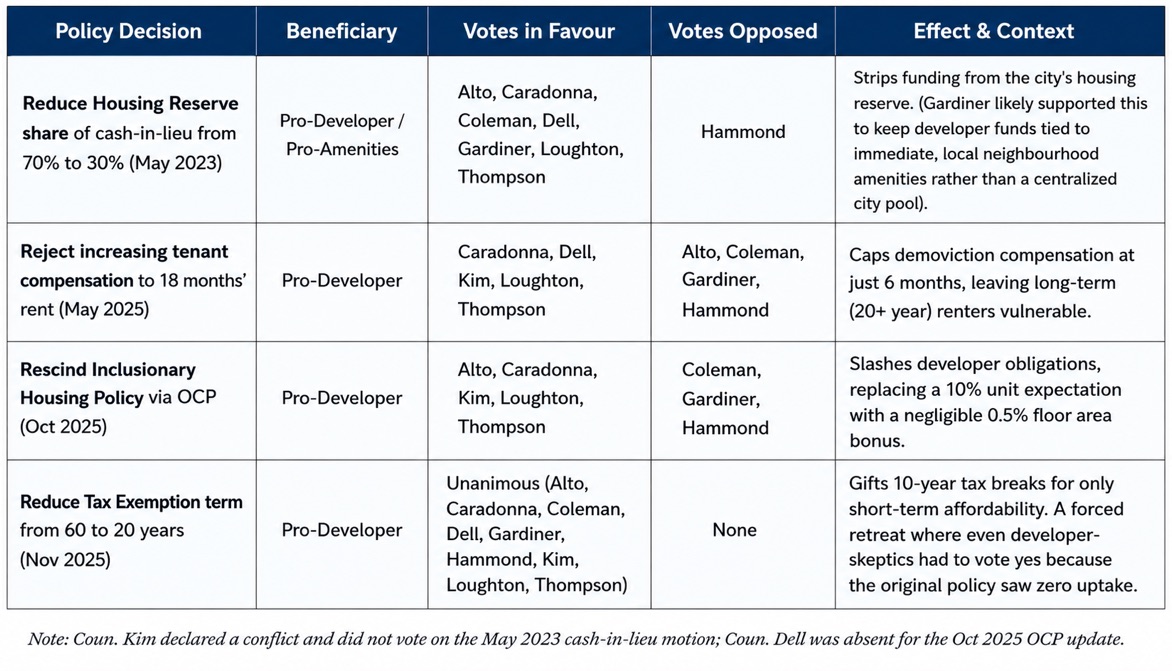
The table below breaks down the key votes since 2023 that have effected this dismantling. There are two blocs on Council: pro-development at all costs; and pro-responsible development. These are my descriptions and I distinguish the latter group from the former based on their willingness to weigh a wider range of factors in coming to their decisions than the pro-development bloc which cannot be bothered.
The Pro-Development Bloc at all Costs consists of Councillors Caradonna, Loughton, Thompson, Dell, and Kim (often joined by Mayor Alto) consistently votes in favour of removing development restrictions and reducing developer requirements.
The Responsible-Development Bloc consists of Councillors Hammond, Gardiner, and often Coleman and who record the lowest rates of "in favour" votes on these types of deregulation versus true pro-housing. They are the frequent, outvoted minority trying to maintain higher baseline standards.
What Hull’s timeline reveals is this bloc's coordinated arrangement for dismantling the baseline expectations developers must meet to do business in Victoria.
First, the bloc targeted the Inclusionary Housing Policy. By reducing the percentage of cash-in-lieu contributions that go toward the Housing Reserve Fund, the majority has actively starved the city's ability to fund non-market solutions. The nuance here is Gardiner's supporting vote, which aligns with her established preference for funneling developer offsets directly into tangible neighbourhood amenities rather than a centralised, often ineffective housing pools. Second, the bloc buried the complete destruction of the 10% affordable unit expectation within the massive Official Community Plan update, replacing it with a 0.5% density bonus that slashed a standard $150,000 cash-in-lieu fee down to just $73,000.
Third, the bloc abandoned renters. In a macroeconomic climate where homeownership has detached from local incomes, protecting existing rental tenures is critical. Yet the Caradonna-led majority blocked an 18-month compensation package for the most vulnerable, namely long-term renters facing demoviction. I return to this in my next post and the ploy of Caradonna, Thompson and Loughton to obscure their anti-tenant record with a motion to have staff study tenant conditions and report back in 12 months, ahem after the election. They were called on it by Gardiner and Hammond.
Finally, Council proved that poorly designed policies inevitably lead to developer giveaways. The Revitalization Tax Exemption was initially sold as a way to secure 60-year affordability, but because it was completely detached from market realities, developer uptake was zero. This forced a unanimous, humiliating retreat to a 20-year term; even reliable Council skeptics like Hammond and Gardiner had to vote with the bloc, pragmatically recognising that an unused 60-year policy generates exactly zero affordable homes.
As Hull rightfully concludes, actions speak louder than words. We cannot zone our way out of an affordability crisis by handing developers public tax breaks, slashing their reserve fund contributions, and refusing to protect existing tenants. When the 2026 election arrives, voters must ignore the campaign rhetoric and hold this specific voting bloc strictly accountable for its record.
NDP Provincial Government Clear Cuts Old Growth While Victoria NDP Municipal Government Clear Cuts Old Neighbourhoods
The provincial and municipal governments are running the exact same playbook. They are fast-tracking irreversible destruction while using the language of protection and modernisation to pacify the public.
The Grand Illusion
Just this week, the five independent experts appointed by the province to map at-risk old-growth forests sounded the alarm. Ecologists Rachel Holt and Karen Price, landscape analyst Dave Daust, veteran forester Garry Merkel, and economist Lisa Matthaus sent a scathing document to Premier David Eby and Ministers Parmar and Neill.
Their message was blunt. The BC government is actively approving logging in the very same rare, irreplaceable forests they were hired to protect. The experts warned that the government’s ongoing clear-cutting is “not just a moral failure but also a high economic, ecological and social risk,” purposely driving these ecosystems toward extinction.
Now look at the “NDP Municipal Government,” or Victoria City Council. Under the guise of the 2050 Official Community Plan, they are executing an identical sleight of hand. The provincial Bill 44 mandate was supposedly designed to “gently densify,” requiring municipalities to allow 4 to 6 housing units on standard residential lots. But the Mayor and Council took that mandate and quietly morphed it into a blanket upzoning that permits 4 to 6 storey apartment buildings across the city’s residential fabric by right.
Gutting Democratic Oversight
To pull off highly unpopular policies, both levels of government had to remove the public from the equation entirely.
The province is simply ignoring its own expert panel, pushing the burden of harvesting decisions onto First Nations without offering any real conservation financing alternatives.
The city’s tactic for avoiding scrutiny was even more brazen. Most public hearings have been banned. Victoria City Council no longer holds public hearings for residential projects that align with their hyper-dense new OCP. To guarantee the bulldozers face no friction, they also passed a delegated authority bylaw. Elected officials and neighbourhood residents have been completely stripped of their voice in the development review process. Unelected staff now have the power to rubber-stamp mid-rise developments that will permanently alter our neighbourhoods.
Misrepresenting the Facts
Neither government is being honest about what they are doing. The Union of B.C. Indian Chiefs recently condemned the province for its ongoing failure to protect these forests, calling them out explicitly for misrepresenting the status of old-growth management to the public.
City Council used the exact same public relations spin. They sold the OCP update to the public as necessary compliance with provincial housing targets. But they blurred the lines between allowing six individual units on a lot and legalising six-storey, lot-line-to-lot-line buildings in historic neighbourhoods like James Bay.
A Legacy of Permanent Erasure
The damage being done right now cannot be undone. Once ancient old-growth forests are clear-cut, the biodiversity loss is permanent. In the exact same way, once historic urban landscapes and mature tree canopies are bulldozed for mid-rise developments under delegated authority, the character of Victoria’s neighbourhoods is erased forever. There is no public recourse. No second chances.
Time to Clear Cut the Council
This goes far beyond bad zoning or poor environmental management. It is a profound breach of the public trust. The Province, the Mayor and the Gang of Five have intentionally bypassed democratic accountability, handing the keys to our city over to developers and unelected bureaucrats.
They have shown us exactly what they value. For the Council it is not the residents or the fabric of this city that matter. It is time for Victorians to push back. The only way to stop the clear-cutting of our neighbourhoods is to vote out the Mayor and the Gang of Five at the next election.
Arthur McInnis is a law professor, former construction lawyer, and candidate for Victoria City Council in 2026. His commentary examines transparency, administrative culture, and the operational realities behind decision-making at City Hall.